
Dumb little embarrassing diary but also it's chinese
Update! Riji now supports Mandarin, Spanish, and Italian. Want another language? Ping me on bsky :)
Want access to a public beta of Riji? Ping me on bsky :)
Everyone says that the best way to learn a language is to use it. HOWEVER! Using a language as a novice sucks.1
Let me explain my theory of the Mystery Question. The Mystery Question will be familiar to anyone who is studying a language. Here’s how it works:
You enter a cafe; you’ve practiced your order over and over on the walk there. “Un croissant, s’il vous plaît.” Or perhaps, “eine Tasse Kaffee, bitte.”
The barista responds with something you’ve also practiced, like “quelle taille?” or something.
You have prepared for this.
“groß, bitte.”
And then… Then the Mystery Question: They ask something inscrutable. What is the second property they could possibly want to know about my coffee? What else could they have asked?!
And the humiliation: Seeing your confusion, they switch into English for you, you poor stupid American. “For here or to go?” Or else, “What kind of milk?” Or something else that you should have been able to say if only you had studied very slightly more. Damn it!
I can always make it through the first round of interrogation. But there will always be a Mystery Question that tips my hand. I am not a savvy Spanish speaker with a funky accent after all. I am merely un farsante.
Let me tell you something else embarrassing that I do:
I keep a dumb little embarrassing diary. I have for years! It’s mainly a place to use my latest fountain pens (Kaweco Sport Titanium, J. Herbin 1670 Emerald of Chivor) but every so often I say something meditative in it.
So sometime in college I had the idea to combine my two embarrassing habits: language learning and journaling. I started writing in Mandarin Chinese in my journal as a way to induce immersion without embarrassing myself with my limited vocabulary: Write a sentence, look up a word, write some more…
My general format — which you are welcome to zoink for your own use — was to use a piece of notebook paper folded in a 2/3 zone and a 1/3 right margin; the left 2/3 was for writing, and the right 1/3 was for calling out new vocabulary, which, because I was writing in Chinese, also included a pinyin transliteration.
My chief complaint — and the reason I more or less stopped — is that it was impossible to have any confidence that I was training myself on proper, native-like grammar or vocabulary.2
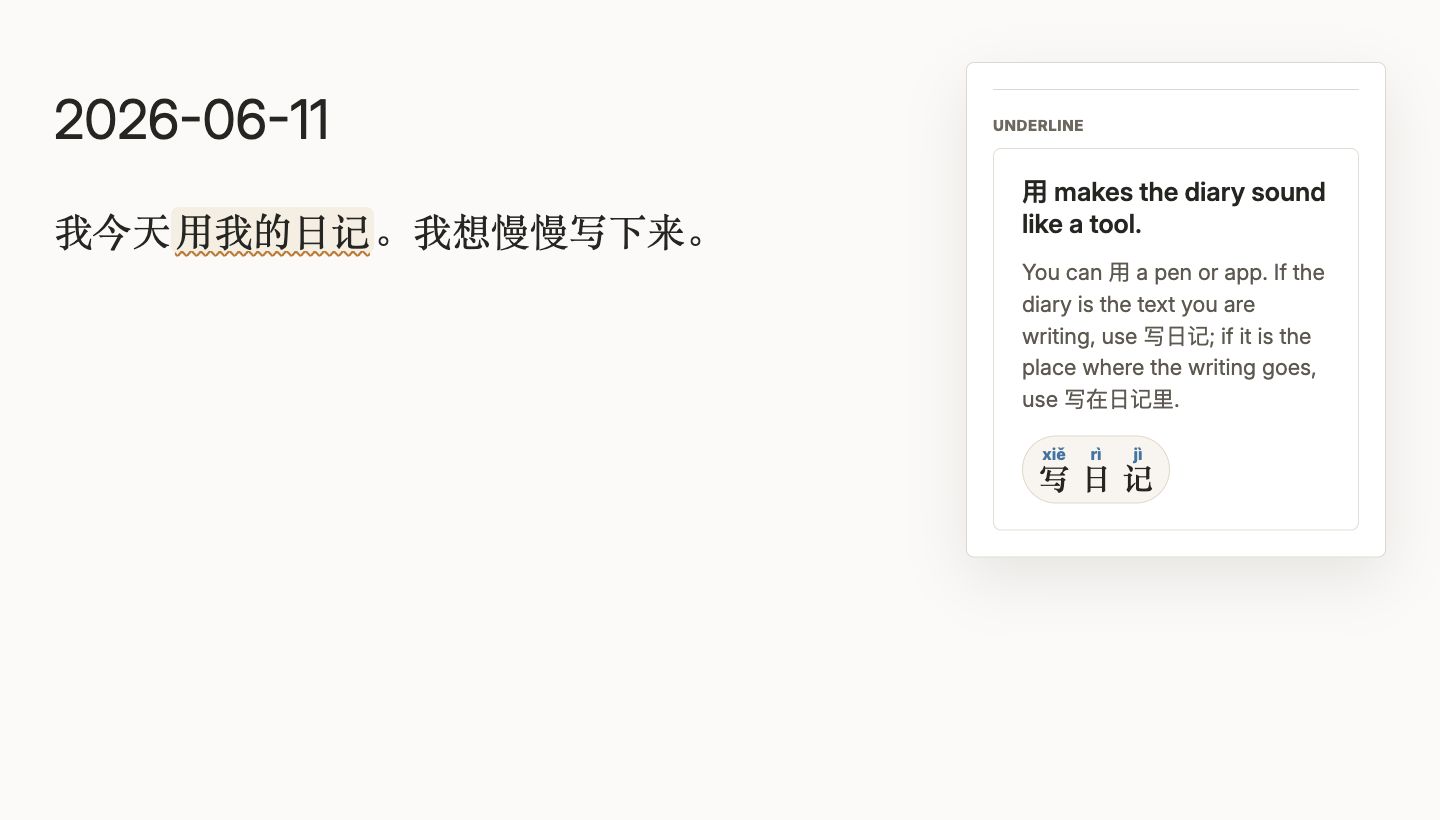
This is the idea I have been toying with in Riji, my little language journaling app. I want the freedom of writing more or less autonomously, but then I want access to language-learning help:
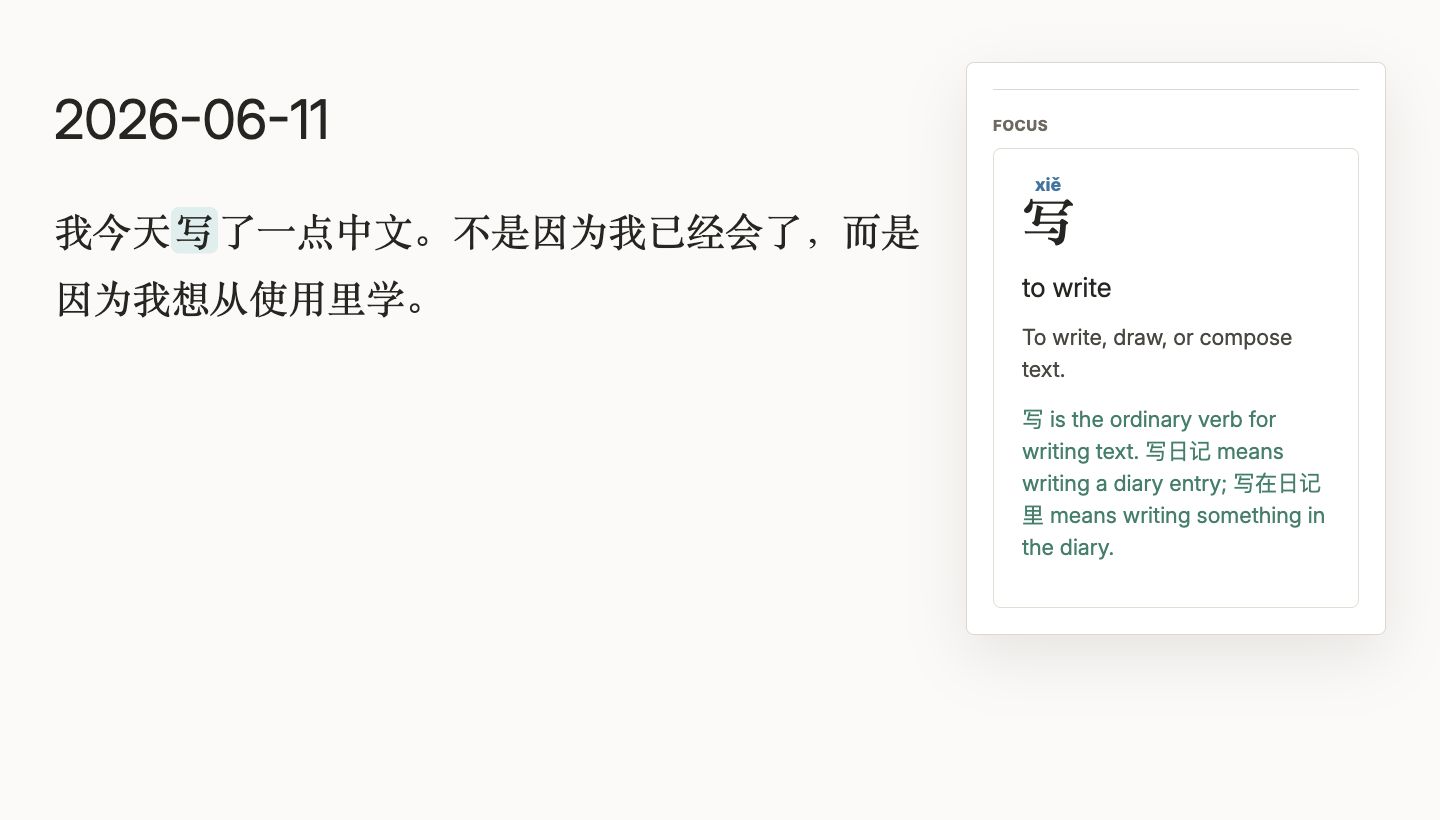
Riji is a mostly blank page that mostly shuts up. You type. After you pause, it gives just enough help to keep going: local dictionary cards, optional transliteration, and underlines for things a teacher would mark.
Riji syncs to either your browser’s storage or to GitHub, so you can keep track of your progress over time. It also tracks “fluency” (in a sense) by comparing your word usage to a Zipfian distribution of word frequencies in the language. (If you have a better idea of how to do this, please let me know!)
The code is open source on GitHub and I am opening a small private beta; email or DM me on bsky if you want to play!
-
The only exception to this I have ever experienced was traveling in China, where people near-universally complimented my Mandarin, even though I know for sure it was abominable. ↩
-
Once, I used a word in a spoken conversation that I had previously looked up and had been using in my journal. My interlocutor made the sort of face that you’d make if someone near you had just farted loudly. “What is it that you think that means?” Reader: I was very mistaken. ↩